“Germanis Gallia clausa” (“Gaul is closed to the Germans”)a was the inscription on the commemorative medal that Louis XIV had struck when he took possession of Strasbourg. In 1679, under the Peace of Nijmegen, he had renounced the right to station troops in Philippsburg. His kingdom was now to be secured in the east and north by a belt of fortresses.¹ Saarlouis was founded in 1680 and formed a single defensive system with the strongholds lying behind it at Phalsbourg (German: Pfalzburg), Marsal, and Metz.
§ 1 The Construction of the Fortress
French Alsace was to be secured with particular care. Thus arose the Rhine Line, with the citadel of Strasbourg (1682) and the fortresses of Huningue (German: Hüningen; 1684), Fort-Louis (1687), and Neuf-Brisach (German: Neubreisach; 1700). A threefold rampart was to close Alsace off to the north: first the Queich Line, with Landau and Germersheim; then the Lauter Line, with the strongholds of Wissembourg (German: Weissenburg) and Lauterbourg; and, farther inland, the Moder Line, with Haguenau and Fort-Louis. Between these fortresses, at intervals of two to three kilometers, strong fieldworks or redoubts were built—or planned—at suitable points along the Rhine and the other rivers just named, so that continuous belts of fortifications gradually came into being.²
“These redoubts were square, measuring about one hundred meters on each side, and stood fifty to one hundred paces from the course of the Rhine. They had a deep, skillfully constructed moat, crossed on the western side by a raised entrance. On top of the square was a circular earthwork shaped like a pan. Here stood the blockhouse, manned in wartime by eight foot soldiers and four horsemen and, in peacetime, by a single watchman, who had to perform the so-called Rhine Watch.”³ Taken together, these fieldworks along the rivers thus formed an important complement to the fortresses.
The German historian A. Schulte⁴ sums up the situation: “Apart from several less important places, the fortresses of Bitche, Homburg, Saarlouis, and Phalsbourg arose against Germany in 1679. The works at Breisach and Freiburg were strengthened. Huningue (with a bridgehead beyond the Rhine) and Belfort were fortified. Below Strasbourg, on an island in the Rhine, rose the fortress of Fort-Louis, its outworks likewise extending across the river. The fortifications at Landau were under construction, and on Veldenz territory above Koblenz rose the fortress of Mont-Royal. The King therefore already controlled four well-fortified crossings of the Rhine. By fortifying Huningue, Fort-Louis, and Mont-Royal, the King had violated the armistice.”b
Fort-Louis belonged both to the Rhine Line and to the Moder Line. It was intended to replace and support a weakened Haguenau while also forming a defense against the Stollhofen Lines on the Baden side.⁵ By about 1680, the lower course of today’s Moder was already connected with the Rhine at Drusenheim; the present-day Moder at Fort-Louis was therefore then a branch of the Rhine.⁶
On contemporary plans, the site on which Fort-Louis was to be built appears as a lightly wooded island in the Rhine. It lay about two kilometers from the eastern end of Rœschwoog. According to the Plan de l’Isle de Giessenheim acquise par le Roi des Barons de Fleckenstein pour y construire la ville de Fort-Louis (“Plan of the Island of Giessenheim, Acquired by the King from the Barons of Fleckenstein in Order to Build the Town of Fort-Louis”),⁷ the island was eleven hundred toises long (one toise = 1.94 meters), or 2,134 meters, and had a maximum width of about 320 toises (620 meters) at the site of the later main fort. Only two branches of the Rhine are shown: the Great Rhine, which passes the Kehres-Batiston houses, and the Little Rhine, also called the Red Rhine—the present-day Moder.
The Rohrgiessen appears as the Rhine’s actual riverbed. The many branches of the Auenheim arm of the Rhine are not shown. The Great Rhine, on the eastern side of the island, has an average width of 110 toises (200 meters); the Little Rhine, on the western side, is 80 toises wide (about 150 meters). The whole of Giesenheim Island, like the banks of the Rhine’s branches, is wooded. Behind the later main fort, a channel cuts across the island. Another channel runs from the Red Rhine, past Contades and the parade ground, to the Great Rhine. Through the island’s southern tip, at the site of the later settlement, winds a road accessible only from the eastern side—that is, from the Great Rhine and Söllingen.
The communal boundary is marked on this plan. According to it, the tip of the island on which part of the later town was built belonged to the district of the Baden municipality of Söllingen, while all the remaining land belonged to the district of Rœschwoog-Giesenheim—hence the name Giesenheim Island. In territorial terms, most of the island was subject to the Lordship of Fleckenstein⁸ and thus ultimately belonged to France.
If the French state wished to build a fortress on this island, it had to reach an understanding both with the owners of the land and with the Lordship of Fleckenstein. How it did so is unknown. What is certain is that Fleckenstein boundary stones still stood in Fort-Louis in 1717 and 1727, and that as late as 1754 the lordship claimed sovereign rights over the island, though not over the town center or the immediate precincts of the two forts.
The occasion was a floating mill resting on barges just below the Moder Bridge, close beside it, which was to supply white flour to the garrison and the military hospital. In 1753 a dwelling was built for the miller on the glacis of Fort d’Alsace; it also served as a wine tavern. The beverage excise payable there was claimed first by the military authorities—whose claim the Intendant promptly rejected—then by the Town of Fort-Louis, and finally by the Lordship of Fleckenstein.⁹ The last produced two records, dating from 1717 and 1727, of its boundary stones in Fort-Louis and demanded either that the tavern be closed or that the excise be paid regularly to the Baron.
The barony’s complaint to the Intendant of Alsace states, among other things:
Tout le terrain sur lequel se trouvent construits les forts de la ville de Fort-Louis du Rhin fait partie du ban de Roeschwoog, village dépendant de la baronie de Fleckenstein … Le Roi en prenant le terrain nécessaire aux glacis du Fort a ôté la propriété de ce terrain aux particuliers. Mais Sa Majesté n’a pas entendu préjudicier aux droits du territoire et de jurisdiction appartenants au Seigneur naturel des lieux. C’est ce qui se voit dans les places de guerre de la province, notamment de Kehl, fortification bâtie par le Roi où M. le Margrave de Baden est demeuré seigneur territorial.
All the land on which the fortifications of the town of Fort-Louis on the Rhine have been built forms part of the district of Rœschwoog, a village dependent upon the Barony of Fleckenstein. … In taking the land required for the fort’s glacis, the King deprived private individuals of ownership of that land. But His Majesty did not intend to prejudice the rights of territorial sovereignty and jurisdiction belonging to the natural lord of the place. This can be seen in the province’s fortified places, notably Kehl, a fortification built by the King in which the Margrave of Baden has remained territorial lord.
No decision is found in the records. The Intendant, too, favored closing the tavern in order to avoid a decision on the underlying question. Thus, at the very founding of the fortress, the relationship between the French state and the Lordship of Fleckenstein had been left unsettled.
In practice, the question was not of great importance. Hoffmann writes:¹⁰
Selon l’interprétation donnée par la France au traité de Westphalie, la souveraineté, en Alsace, appartenait exclusivement au Roi, et les seigneurs, quels qu’ils fussent, n’étaient plus ni co-impérants, ni co-souverains, et avaient perdu par conséquent tous les droits qui découlaient de l’exercice de cette souveraineté.
According to the interpretation France placed upon the Treaty of Westphalia, sovereignty in Alsace belonged exclusively to the King, and the lords, whoever they might be, were no longer co-rulers or co-sovereigns and had consequently lost all rights arising from the exercise of that sovereignty.
In 1872 the question of the old district and seigneurial boundary was debated briefly for the last time. The German government intended to sell the fortifications, and the municipality of Rœschwoog also sought to acquire them. Among other grounds, it pointed out that before the fortress was built, Giesenheim Island had belonged to the district of Rœschwoog-Giesenheim, and that it was therefore fitting that the land should now pass to Rœschwoog as municipal property. On 21 April, the municipal council of Fort-Louis rebutted all of Rœschwoog’s assertions with sound arguments. With regard to the origin of the fortress, however, out of understandable concern for the common land, it ventured the following, less than fortunate, historical excursus:
In 1687 the town and fortress were established on swampy, uninhabited islands in the Rhine, most of which belonged to the Margrave of Baden and were ceded to Louis XIV by the Treaty of Ryswick. The name Fleckenstein does not appear at all in the official records; nor is there anything from the municipality of Rœschwoog itself.
Qui nimium probat …—he who proves too much …c
Even though the municipality of Rœschwoog’s assertions were historically correct, it still could not derive from them, two centuries later, any preferential right to acquire the military land.
The principal purpose of building the fortress was not only to secure the frontier against enemy attack but also to create a new crossing of the Rhine. The entire original design, with its bridgehead on the Baden side, points unmistakably to this purpose. Vauban himself acknowledged it, and the Mémoire sur l’Alsace of 1734¹¹ states:
Le Fort-Louis du Rhin est dans une île isolée de toutes parts … On l’appelait autrefois l’île de Guisenheim, ou l’île des Chenapans. Elle appartenait en partie à la puissance de Bade et en partie au Baron de Fleckenstein. Louis XIV s’en étant rendu maître, y fit construire un fort en 1687 pour s’établir un passage sur le Rhin entre Strasbourg et Landau.
Fort-Louis on the Rhine stands on an island isolated on every side. … It was formerly called Guisenheim Island, or Rogues’ Island. It belonged in part to the dominion of Baden and in part to the Baron of Fleckenstein. Louis XIV, having taken possession of it, had a fort built there in 1687 in order to establish a crossing of the Rhine between Strasbourg and Landau.
In November 1686, four battalions of soldiers were ordered here to carry out the work. On 26 November, notices seeking laborers, contractors, and suppliers for the fortress works appeared on Strasbourg’s bill-posting columns. The Margravial Government of Baden-Baden had already heard rumors that the French government intended to fortify the Rhine Line between Strasbourg and Philippsburg. Only now, however, did it receive certain information and unimpeachable evidence. It regarded the entire undertaking as a violation of the Peace of Westphalia and a danger to the Empire, particularly to the Margraviate. On 2 December, it therefore informed both the government of Baden-Durlach and General Count von Stahremberg of these events. It also instructed its delegates to represent German interests at the Imperial convention then in session at Regensburg and at the more restricted convention at Ulmd. The letter to the government of Baden-Durlach reads as follows:¹²
Most Serene Prince, Most Gracious Lord! For some time it has been rumored that the royal French side intended to fortify one place or another on the Rhine between Strasbourg and Philippsburg. We here have not failed to ascertain the true circumstances of the matter. It has now proved to be a fact that the Crown of France has actually begun to construct a fort of four bastions on an island known as Geissenheim Island, situated almost in the middle of the Rhine between Hügelsheim and Söllingen. According to a reliable report received here, much timber and brush have already been felled on that island; several vessels with wheelbarrows and rafts of planks have also been brought there. Reliable intelligence from Strasbourg further reports that the letting of this work was posted there on the 26th of the month of November just past and that four battalions were ordered to complete it; they have already arrived at that place.
Now, although the said island does not lie within the territorial jurisdiction of His Serene Highness our Most Gracious Lord, but is Fleckenstein land and soil, this may nevertheless prove highly prejudicial not only to the Margraviate of Baden, which lies nearest, but also to the other neighboring lands on the Rhine, indeed even to the entire Holy Roman Empire, on account of the consequences to be feared. Moreover, the construction of such a fort between Basel and Philippsburg runs directly contrary to the Instrumentum Pacis Westphalicae. Because this matter therefore concerns the common cause, we have not failed, in the absence of His Serene Highness our Most Gracious Lord, to bring it most humbly to the attention of Your Princely Highness. We respectfully submit whether this matter of such far-reaching importance—which we have likewise not failed, as duty bound, to report to His Serene Highness our Most Gracious Lord—should not perhaps be brought as speedily as possible before the Imperial convention still in session at Regensburg, so that it may, in view of its importance, be subjected to prompt and mature deliberation and whatever is found useful to avert it may be provided for in good time. With this, we humbly commend ourselves to Your Princely Highness’s favor and grace.
Baden, 2 December 1686. Your Princely Highness’s most humble and obedient servant, the Princely Margravial Baden President and Privy Councillor, also Court Marshal.
We shall trace this protest movement in the Holy Roman Empire further in the third section. From the outset it had no prospect of success. That became apparent within the next few weeks. Even before the end of the year, a Baden scout reported that work was beginning simultaneously on redoubts and half-bridges across the Rhine:¹³ “On the large Rhine island near Hügelsheim-Greffern, about half an hour from Schwarzach, a redoubt is being laid out. A complete bridge has been built to it from one bank of the Rhine, though in such a way that vessels can still pass.” The other side (toward Greffern), he continued, was open, but very narrow. Beyond the Rhine, various bridging materials lay ready, so that within a few hours the bridge could be completed from the redoubt to the near bank. The Kohlenguss forest, which belonged to Schwarzach Abbey, was to “be cut down and cleared in order to widen the field of view from the fortress of Fort-Louis.”
This last statement about clearing the forests cannot be dismissed. For if Fort-Louis was to fulfill its purpose, the Rhine forests had to be felled and cleared over a wide radius, especially on the right bank in wartime.
On 6 January 1687, the royal fortress architect Vauban personally laid the fortress’s foundation stone. Immediately after the ceremony, twelve meters of masonry were erected. Writing from Strasbourg on 7 January 1687, he reported the event to Louvois, the Minister of War:¹⁴
Celle-ci, Monseigneur, est pour avoir l’honneur de vous dire qu’on a hier commencé la fondation du Fort-Louis, j’en ai posé la première pierre, en suite de quoy on en fit environ six toises de long, cela va continuer présentement.
This, My Lord, is to have the honor of telling you that yesterday the foundations of Fort-Louis were begun. I laid the first stone, after which about six toises of masonry were built; the work will now continue.
Sébastien Le Prestre, Marquis de Vauban (1633–1707), had entered military service at the age of seventeen and had become a military engineer by twenty-two. His inventive mind simplified and expanded the system of siege warfare. Thus he was able to conduct the sieges of fifty fortified places in all, every one successfully. A proverb ran: “Citadelle assiégée par Vauban, citadelle prise”—a fortress besieged by Vauban is a fortress taken.
In response to this method, Louis XIV created a corps of military engineers and placed Vauban at its head with the title of Commissioner General of Fortifications. For forty years Vauban traveled tirelessly from one frontier of the kingdom to another, working on construction plans and supervising work at some three hundred fortified places. His principal achievement was the fortification of the northern frontier in Flanders, where no natural obstacle could have stopped the enemy.
Vauban is regarded as the most capable military engineer of his age. He introduced a new defensive system that was imitated in other countries and retained in its essentials into more recent times. The fortress’s main wall, or escarp, was built ten meters high and sturdy, for on the inside it was heavily protected by earthworks.
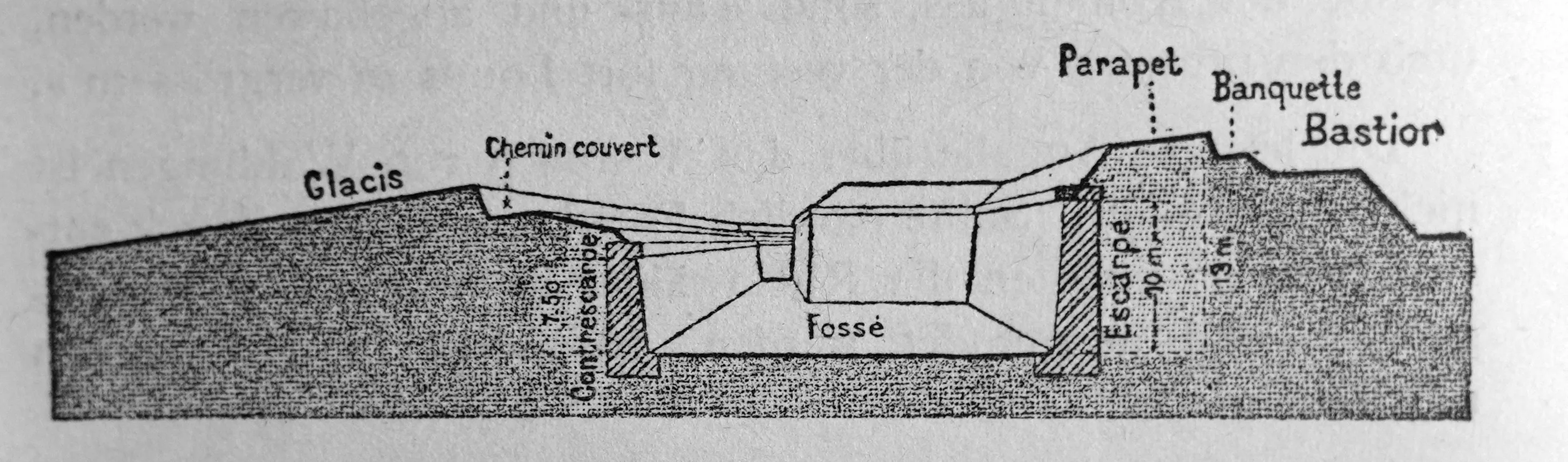
The wall itself, however, was not visible from afar. Instead, it was covered by a high, firm, grassed earthwork—the parapet—which alone could be seen and whose mass of earth enemy projectiles could not appreciably damage. Outside the main wall lay a broad water-filled ditch and, halfway up, a covered way. The whole was protected by the glacis, large earthworks that sloped gradually downward toward the outside. Thus, at no point did the fortress offer a sharply defined target visible from afar. Nevertheless, two protected defensive lines ran all around it: one on the covered way of the glacis, at a height of about nine meters; the other behind the main embankment of the fortress wall, the parapet, at a height of about twelve meters. Vauban designed the whole main fort geometrically, with four or five bastions tapering into horn-like points, so that in ground plan it resembled a star.
The fortress of Fort-Louis was built according to Vauban’s plans and was therefore modern and well suited to its purpose by the standards of the time.¹⁵ It consisted of the main fort—the Fort carré, with four bastions¹⁶—two bridgeheads, and two redoubts. The main fort was built roughly in the middle of the island and connected on both sides with the branches of the Rhine. Its dimensions were therefore dictated by the site. A little extra length was allowed, producing a rectangle. Each of the complex’s four corners tapered into a horn-like bastion. In the middle of each side, a convenient covered passage—still called a souterrain today—was built and protected by a demi-lune. The whole main fort thus formed an octagon. Including the demi-lunes, it measures 450 meters from north to south and 380 meters from east to west. Within the fort, an area of about 225 × 180 meters remained available.
A bridgehead was projected beyond each of the two Rhine branches, toward the Baden side and the Alsatian side respectively. The small fort on the Baden side, Fort-Marquisat, lay to the right of the thalweg and therefore within the territory of the Margrave of Baden, as its name itself indicates. Because war had broken out while construction was still under way, the French authorities could venture this encroachment upon foreign territory without misgiving. Under the Treaty of Ryswick (1697), however, Louis XIV abandoned this work on the right bank of the Rhine, as he did at Huningue and Kehl. After being briefly restored once more during the War of the Spanish Succession, it was abandoned for good under the Peace of Baden (1714).¹⁷ The Alsatian bridgehead facing Rœschwoog, Fort d’Alsace, was expanded all the more in compensation.
The fortifications were completed by two redoubts, one on the so-called Grosser Kies (Great Gravel Bank) and the other at the Hoher Berg (High Hill), which guarded the island’s northern and southern tips, where the Rhine and Moder diverged and then reunited. Around the island, fifteen irregularly shaped bastions were built and connected with one another by intermediate ramparts known as curtains.¹⁸
The available waters of the Rhine and Moder were used extensively for purposes of fortification. Every individual work, even the demi-lunes, was surrounded by water, indeed several times over. The inevitable rampart ditch also encircled the entire island.
Within the Fort carré, also called the Fort du Gouvernement, the military church and some ten barracks and administrative buildings were erected.¹⁹ The military hospital could be housed in Fort d’Alsace.²⁰ There was not, however, sufficient space for the various storehouses. They therefore had to be moved outside the fortress, into the open fields or the settlement. Beyond the main fort, in the direction of Neuhaeusel (German: Neuhäusel), stood a long shed for drying laundry, the clothing office, and separate storehouses for construction timber and firewood.²¹ The military bakery was moved to the Rue Neuve. A plot in the fields of Rœschwoog, about three hundred meters downstream from Fort d’Alsace, was designated as the military cemetery. The so-called royal tree nursery above the Moder Bridge, on the Rœschwoog side, was in fact merely an orchard and vegetable garden for the senior officers.²²
Occasional entries in the parish registers suggest the following names as the architects and contractors of the fortress works: François Favre de Beauregard, capitaine au régiment de la marine (captain in the Marine Regiment), director operum Fortalicii Ludovicaei, eques Ordinis Sancti Lazari (director of the works of Fort-Louis and knight of the Order of St. Lazarus), 1690; Louis Morel, capitaine dans le régiment de la marine et directeur des fortifications du Fort-Louis (captain in the Marine Regiment and director of the fortifications of Fort-Louis), 1689; Nicolas de Ladouce, capitaine au régiment du Luxembourg et premier ingénieur des fortifications du Fort-Louis (captain in the Luxembourg Regiment and chief engineer of the fortifications of Fort-Louis), 1695; Jean-Baptiste Lefebre, entrepreneur en chef (chief contractor), mentioned as early as 1688 and died here on 15 June 1724; Claude and Louis Boucherat, entrepreneurs des fortifications (fortification contractors), 1690; Nicolas Pagnwy, contractor, 1691; Charles Antoine Varenne, from Locarno, contractor, 1689; and Nicolas Vornet, contractor, 1691.
Together with the garrison and the communities subject to corvée labor, these gentlemen had work in abundance. The entire island had to be cleared of trees, bridges built, and roads laid. The banks of the Rhine had to be protected with fascines and sluices from the wild floods of the unbridled river. Casemates were built all around the edge of the island; they both protected the site from flooding and were intended to serve as shelters and fieldworks in wartime. And then how many stones and cubic meters of earth were needed to raise the ramparts of the main fort and the two bridgeheads!
Almost all the communities of the Alsatian and Baden lowlands had to provide corvée laborers, wagons, and horses for work on the fortifications. Kocher names Oberhoffen-sur-Moder (German: Oberhofen), Bietlenheim, Drusenheim, and Rountzenheim (German: Runzenheim).²³ The Margraviate of Baden in particular was called upon to provide labor and supplies for Fort-Louis during the war years 1688–1697.
Thus, Baden laborers owed a baker in Fort-Louis two hundred guilders for bread, a debt that they were not able to pay until 1691. In 1691, 150,000 fascines were requisitioned, which the Margraviate of Baden had to deliver here by December.²⁴
The neighboring community of Beinheim,²⁵ being under margravial rule, was also subjected to a special war tax. The French authorities forced it to demolish its town wall and castle and carried the stones to Fort-Louis.²⁶
As early as 1677, a punitive expedition had brought the town of Haguenau to heel, razed most of its fortifications out of distrust of the townspeople’s loyalties, and burned the old Barbarossa Castle. This released many dressed stones and ashlar blocks, which were requisitioned for Fort-Louis and delivered by water. Father Malachias Tschamser reports on this in the Thann Chronicle:²⁷
On 26 February 1686e, they began laying the foundations of Fort-Louis, the new royal French fortress, and built most of that fortress from the old castle and other fine stones and ashlar blocks from Haguenau. – In that summer of 1697, the fortress of Fort-Louis on the Rhine was completed and made into a formal fortress with stones from the old imperial castle at Haguenau, which had been conveyed through the Moder into the Rhine and carried there by boat.
The stones from the demolished castle at Seltz also came to Fort-Louis.²⁸
A work published in Hamburg in 1695²⁹ contains the following brief particulars concerning the new fortress:
It lies opposite Stollhofen on the Baden frontier and is a regular quadrilateral, which the French laid out in the year 1686 on an island in the Rhine and fortified with imposing outworks, including works on both banks of the Rhine to protect the pontoon bridges established there. It is now regarded as a principal fortress and a strong crossing over the Rhine. The sentry boxes on the ramparts are built of red stone, and their tops are entirely gilded, which makes a very fine sight. Yet this fortress remains in very great danger when the Rhine rises, for a few years ago the side facing Strasbourg was washed away and thereby opened up. It was soon closed again, however, and restored to its former condition. It is very harmful to the Empire.
The Peace of Ryswick (1697) led once again to extensive fortress construction. For now the bridgehead on the right bank of the Rhine had to be evacuated, and Fort d’Alsace enlarged to compensate for its loss. Thus we find Vauban here again in August and September 1698.³⁰
His presence is documented for a third time in October 1703, when the fortress had to be put into a state of readiness for war, the harbor enlarged, and its supply facilitated by means of an inland canal from Seltz to La Wantzenau (German: Wanzenau).³⁰
This inland canal,³¹ built in 1703, was intended to complement the fortress to good effect. Beginning at the Rhine near Seltz–Beinheim, it ran through the sheltered hinterland east of Beinheim and Roppenheim and skirted the last houses of Rœschwoog. It then crossed the open country in a broad curve and entered the Moder at the Flossholzgiessen, just above Fort d’Alsace. Upstream it ran close by Rountzenheim, passed through the middle of Sessenheim, and entered the Ill at La Wantzenau. Existing backwaters and ditches were widely used in constructing the canal. Although this made the work easier, it left the watercourse winding and difficult to survey. The canal was intended to replace navigation on the Rhine and, in wartime, to secure the provisioning of the fortresses when the enemy controlled the river. First and foremost, it benefited the fortress here. Its operation ceased, however, with the conclusion of the Peace of Vienna in 1738.³²
Brickworks arose over a wide area around Rœschwoog and Neuhaeusel to fire bricks and roof tiles. The raw material required for them was taken from the ground on the spot. These works were demolished, however, during the War of the Spanish Succession so that they could not serve the enemy as strongpoints.³³ In 1754, a clay pit on the “Kühweid” is mentioned once more, together with a demand that it subsequently be filled with rubble.
Remarkably, the construction of Fort-Louis led to the creation of the village of Büchelberg near Lauterbourg. Meyer writes on this subject in his History of the Town of Lauterbourg:³⁴
In the middle of the Bienwald, beyond Lauterbourg in the southeastern Rhine Palatinate, lies a large oasis of farmland and a quiet village on a hill: Büchelberg, so called after the beeches that border its fields. The village came into being toward the end of the seventeenth century. When the fortress of Fort-Louis was built, the lime required for it was quarried here. At the same time, a large brickworks was established. Woodcutters prepared the timber needed to build the fortress. The resulting workers’ colony consisted mainly of Picards, which is why French family names are still found there today. In 1692, they received the allotted woodland and their rather small communal territory. In 1766, they built a church, which was at first served from Lauterbourg.
Most of Büchelberg’s inhabitants still bear French names today: Labbé, Barlément, Masset, Gotard, Meunier³⁵ . . .
It is unlikely, however, that the construction of the fortress had any appreciable influence on the establishment of the neighboring community of Neuhaeusel.³⁶ The two places did admittedly arise at about the same time, but the immediate occasion for settlement at Neuhaeusel was the burning of Hügelsheim on the right bank of the Rhine in 1689. This will be mentioned several more times in the course of this history. Neuhaeusel is therefore a few years younger than Fort-Louis. No French family names are found there. Until the Revolution, the place belonged to the Margraviate, and thus to Baden, and was frequently on the enemy side. Neuhaeusel also belonged to the parish of Hügelsheim for thirty years and was not joined to the parish of Beinheim until 18 October 1721, because sick calls and burials were often made difficult by the Rhine.³⁷ The earliest beginnings of Neuhaeusel thus lead back to Hügelsheim, not to Fort-Louis.
Vauban, according to whose plans Fort-Louis was built, believed that this elongated redoubt would command navigation on the Rhine, secure the river crossing, and promote trade between its two banks. Thus, he thought, this fortified place would in time be able to supply Strasbourg and the other fortresses of the country with provisions. These fine hopes, however, were fulfilled only to a rather modest degree.³⁸
Another of his statements must likewise be judged rather optimistic. In an undated document, he wrote that, with three battalions and sufficient ammunition, he would hold the fort in such a way that no German could enter it; he would allow his hands to be cut off as a pledge of this assertion.³⁹
§ 2 The Garrison
At the head of the garrison there were always a governor and a fortress commander, the so-called Lieutenant de Roi.
Occasional references yield the following list of governors:
M. de Brégi, until 1689. In the summer of 1689, a shell exploded and shattered his foot, which was amputated immediately. His life remained in danger, however. De Brégi had spent most of his life wholly estranged from God. It was said that he had formerly been a Jesuit and had studied a great deal. The local parish priest, Father Vostelet, visited him and brought about his complete conversion. Before several of his officers, De Brégi declared that he would gladly make a public recantation before his troops on account of his unchristian way of life. He died five or six days after the accident.¹ His body was buried in the “old church.” On 7 May 1690, however, it was exhumed on the orders of Vicar General de Cartigny and solemnly reinterred in the newly built church in the center of the town.²
M. de Ronville, mentioned in 1690.
Pierre de la Vaisse, mentioned in 1697 and 1712, chevalier de l’Ordre militaire de Saint-Louis, lieutenant-général des armées du Roi; he died at Fort-Louis on 7 March 1712, at the age of eighty-four, and was buried in the parish church.
M. de Parmade, 1715.
Gabriel de Chouly, Comte de Permangle, chevalier de l’ordre de Saint-Louis. Mentioned from 1717 to 1738. A side street in Fort-Louis still bears his name today.
Louis-Georges-Erasme, Marquis de Contades, Maréchal de France. He was governor of Fort-Louis from January 1758 and remained in office until the Revolution. He may seldom have come here, for in 1759 he directed military operations in Westphalia, and in 1763 he advanced to the post of Commandant en chef en Alsace. He died at Livry, near Paris, in 1793 at the age of eighty-eight.³ As in Strasbourg, a public square here bears his name.⁴
Unlike the first governors, the later ones no longer resided in small garrison towns such as Fort-Louis, Haguenau, Huningue, Landau, and Phalsbourg. Their most important task consisted in receiving an annual salary of twelve thousand livres.⁵
— Alongside the governor, the actual administration lay in the hands of a fortress commander, the Lieutenant de Roi. The following gentlemen are mentioned from time to time:
René de Saint-Georges, 1694, 1698.
Charles Boisneau, Sieur de Pralon, escuyer, chevalier de l’ordre militaire de Saint-Louis, 1707–1717. The western lane along the cemetery bears his name.
Roland Théodore Pelissier de Chavigny, chevalier de Saint-Louis, conseiller au Conseil Souverain d’Alsace, 1726; he died on 10 September 1727.
Guillaume Berbi de Mailly, 1728–1736.
Philippe de Saint-Remy died in March 1738; Claude-Alexandre de la Cour, 1738; Melchior Le Brun, 1744–1748; Jean-Baptiste de Verlhac, chevalier de Saint-Louis, 1758–1776.
Antoine Mariez d’Unienville, 1777–1791. In 1791, good patriotsf complained repeatedly that he was not showing enough zeal. Out of consideration for his age, the departmental administration refrained from an inquiry, but announced that he would retire on 1 August 1791.⁶
In general, the local garrison changed very frequently, and so did its officers, all of whom belonged to the nobility. A hundred names of officers stationed here could be cited from the parish records. Only the military officials lived here permanently, often for decades: the serving major and the Commissaire de guerre, the engineers of the fortress works, the physicians of the military hospital, and the directors of the various magazines.
All correspondence converged in the war commissary’s office. He formed the link between the civil and military administrations and represented the Intendant in military affairs, just as the Royal Praetor had to represent the Intendant’s interests before the town council. The list of war commissaries contains the following names:
Antoine Aymier, conseiller du Roi, mentioned from 1694 to 1707; François de Moignon, escuyer, conseiller du Roi, 1710; Goussaud, 1719; Emanuel Mignon dit Saint-Denis, 1724; Louis-Adrien de Sucy de Saint-Germain, 1727–1733; Leroux, 1733; Nicolas de Largillierre, conseiller du Roi, 1735–1743; Jean-François Gaucher de Praslin, chevalier de Saint-Louis, conseiller du Roi, 1748–1779, who died here in the latter year; Louis Gaucher de Praslin, 1779–1789.
The military engineers, too, made their permanent homes here for long periods. Even after construction of the fortress had been completed, there was always work enough for them, if only because of the impetuous Rhine. The following gentlemen therefore continued the work of the building directors named in the preceding section:
Claude Daumont, escuyer, capitaine au régiment de Champagne et ingénieur en chef des fortifications du Fort-Louis et des bords du Rhin, 1705; Emanuel Mignon, entrepreneur de bois de l’artillerie de cette place, 1705; Denis Renaudin, entrepreneur de la serrure pour les fortifications de cette place, 1704; Antoine Rodier, entrepreneur de la charpente pour le Roi de cette place, 1705; Michel Jaussey du Breuil, ingénieur en chef, from 1731 until about 1739; Alexis Roger de Freville, chevalier, capitaine de la légion du Luxembourg, ingénieur en chef, who in 1745 married the daughter of his predecessor just named; Jacques Latour de Clari, operum bellicorum machinator, 1731; Charles de Salmon, capitaine de la légion de Picardie, ingénieur en chef, 1741; Paul-Louis-Antoine de Rozières, chevalier de Saint-Louis, capitaine au corps royal d’artillerie et de génie, ingénieur en chef, 1756–1763; Norbert d’Artus, militiae pedestris capitaneus et bellicorum operum machinator in hac urbe, 1763; Charles-Denis Daumont, 1763; François-Joseph Daumont, 1764; du Caarel, ingénieur en chef, 1776; Adrien de Laleu, capitaneus genii huius civitatis eiusque commendans, 1779; de Chambarlhiac, capitaine du génie, 1788; Joseph-Marie Charpentier, father of the later Baron Germain; Louis Charpentier, entrepreneur des fortifications de cette place, entrepreneur des bois et lumières à l’hôpital militaire. Joseph-Marie and Louis Charpentier were half-brothers.
There were many physicians, both with the military and in the town. In addition, some passed through here from time to time in the company of units from elsewhere. The following gentlemen can be shown with certainty to have resided here and to have practiced partly among the garrison and partly among the townspeople:
Pharmacist Franz Barris, from 1694; pharmacist Laurent Le Roux, 1695; Jean Flavigny, 1697; Alphonse Desportes, chirurgien major de l’hôpital, 1698; Johann Jakob Vichart, 1698; Claude Rivier, apothicaire et directeur de l’hôpital, 1698; Mathias Regenold, 1703; Johann Seiler, 1705; Jean Jeandrau, chirurgien à l’hôpital, 1711; Jean-Baptiste Delemps, chirurgus, vice-maior xenodochii, 1695–1731; Barthélemy Jobert, 1721; Antoine Boissonnet, 1721; Johann Jakob Ulmer, 1724; Georg Heinrich Knöpfler, 1724; Jean-Philippe Desportes, son of Alphonse, 1729; Claude Desportes, apothicaire de l’hôpital, 1736; Georges-Joseph Roger, 1742; Pierre Larrien, 1742; Charles-Louis Rody, apothicaire de l’hôpital, 1744; Dominique Simon, apothicaire de l’hôpital, 1744; Joseph Delemps, 1743; Nicolas-Mathieu Lanier, 1744; Nikolaus Meister, 1745; Mathias Mary, 1746; Johann Peter Amann, 1746; Jakob Hildenbrand, 1750; Jean Saladin, 1750; Joseph Jannot, 1751; Jacques Massé, chirurgus, vice-maior xenodochii regii, 1751.
Prosper Joseph Bosque, 1755; Benedikt Nuhr, 1760; Paul Wanner, 1760–1785, previously a physician in Mothern; Claude-François Touvet, 1761–1788; Johann Binder, 1762; Jacques-François Milien, chirurgien-chef de l’hôpital, 1771; Karl Friedrich Stoltz, 1776; Mathias Leo, 1780; Joseph Saladin, 1781.
Some of the gentlemen named were certainly mere quacks. It inspires little confidence, for example, when one man is described as a physician and teacher of German, and another even as chirurgus et caupo—physician and innkeeper.
Of the many directors of the various military magazines, only Jacob Broy is important to local history. He came from Woignon in the Diocese of Verdun, was at first a military official in Lauterbourg, and here in 1762 married Marie-Madeleine-Renée, daughter of the local military paymaster Robert d’Inarre, whose post in the provisioning office Broy later took over. Broy acquired various pieces of real estate here, which later passed by marriage to Jacques-Louis de Masseys, capitaine de la légion royale Corse. This de Masseys estate, situated between Rœschwoog and Fort-Louis, was sold at public auction in ninety-one lots in 1817.
A survey of the grain stocks held in the garrisons in 1776 gives us a glimpse into the magazines of Fort-Louis.⁷ They were under the direction of Jacob Broy, who received an annual salary of twelve hundred livres. The following stocks were on hand: 925 metric hundredweights of wheat, 274 metric hundredweights of rye, and 783 metric hundredweights of flour. All the garrison’s grain was milled in the mills at Beinheim and Forstfeld. Bread was made with two-thirds wheat flour and one-third rye flour.
In the summer of the same year, the men complained that the bread from the military bakery frequently contained grains of sand. The local officers acknowledged the fact and blamed the fierce wind that sweeps across the land from time to time and drives dust even through shutters and windows. The provisioning office in Strasbourg also opened an inquiry, but wished the defect to be regarded as nothing more than an entirely accidental occurrence.
At first the garrison was quite strong; at times some two thousand men were stationed here,⁸ troop formations from the most varied regiments, which changed frequently.
What follows is at least an attempt to determine which regiments were stationed here in the individual years. I must, however, first make a few preliminary remarks:
The only sources that could be consulted were the local parish registers⁹ and, for the period from 1716 to 1777, the death records of the military hospital.¹⁰ The account of the regiments and other troop formations therefore cannot be exhaustive, since a birth, marriage, or death did not necessarily occur in every formation while it was stationed here. Nevertheless, those regiments that were posted here for a longer period are covered.
The companies have not been listed. Each company bore an officer’s name. There are so many such names—they run into the thousands—that reproducing them would have increased the length of this work substantially. Moreover, the spelling of these company names is frequently incorrect or superficial and misleading.
In wartime, soldiers from eighty to a hundred different troop formations were sometimes in the military hospital. To avoid overburdening the lists and to preserve a clear overview, a certain degree of restriction was therefore necessary even in enumerating the regiments. Accordingly, only those regiments that were evidently stationed here for a longer period were included in the list.
The strength of the individual troop formations stationed here cannot be given. The records do not allow us to decide whether, in any particular case, an entire regiment or only a battalion, several companies, or merely detachments were present. The reader should therefore not be misled: the appearance of a regiment in the following list does not mean that it was stationed here in its entirety.
Despite these necessary limitations, the following overview may be of some interest. The presence of the following regiments can be documented:
1688 Régiment Vermandois.
1689 Rgt Fequier, des Vaisseaux, and Vermandois.
1690 Rgt Fequier, Normandie, Piémont, and Stoupa.
1691 Rgt d’Anjou.
1692 Rgt du Dauphin.
1693 Rgt de la Marine and Royal.
1694 Rgt Bourgogne, Normandie, and Royal.
1695 Rgt de la Marine and Normandie.
1696 Rgt Picardie and Thirasse or Tirage.
1697 Rgt Dauphiné, Labour, Mareilly, de la Marine, Melun, Nivarest, and Piémont; Milice de Henaut.
1698 Rgt Bear, Comte du Gal, Irlandais de Simerie, Normandie, and Piémont.
1699 Rgt d’Anjou, first and second battalions, Comte du Gal, Conflans, and Normandie.
1700 Rgt d’Anjou, first and second battalions, and Conflans.
1701 Rgt d’Anjou, Béard, Conflans, and La Marche.
1702 Rgt d’Artois, d’Auxerrois, Baugelois, Champagne, Daffel-étranger, Daltet, and Provence.
1703 Rgt d’Auxerrois, Baugelois, Courière, Fois, Luxembourg, first and second battalions, and Orléans.
1704 Rgt de Beauce, Chartres, Condé, Prince de Croy, and Guitan; Compagnie franche de M. de Rochois.
1705 Rgt de Beauce, Brossia, Forest, Provence, Saume, Saurbeck, Tessu, and Vendôme; Compagnie franche de M. de Rochois.
1706 Rgt Brossia, Champagne, Coupaux, Crouy, Dussi, Luxembourg, Navarre, Perry, Pontan, Pontieux, Provence, and Toulouse; Compagnie franche de M. de Rochois.
1707 Rgt de Beauce, Beaujeu, Brossia, Charmoisel, Champagne, Chauffenbourg, Crouy, Dussy, Forest, and Franlieu.
1708 Rgt Bretagne, Charmoisel, Chastilet, Coissieux, Crouy, Permangle, Rodmach, Royal Comtois, Saint-Sernin, and Sommery.
1709 Rgt Charmoisel, Meuval, and Permangle.
1710 Rgt Charmoisel, Fief campé à Söllingen, Maumont, Meurat or Morath, and Rgt d’Orléans; Compagnie de M. de Thorigny.
1711 Rgt d’Angoumais, d’Autien campé au Marquisat de Baden entre le Fort-Louis et Söllingen, Bérard, Bissiy, Blesois, Boissec, Forsac campé au Fort de Söllingen, Luque, Moroque, d’Ocart, also written Aucard and Hocard, Toulouse campé au Fort de Söllingen, Trecesson, and Versailles; Compagnie franche de M. de Thorigny.
1712 Rgt Bérard, Dubourg, d’Hocard, Medoc, Tallord, Toulouse, Trecesson, Trissoy, and Versailles, as well as the companies Santori and Thorigny.
1713 Rgt Bérard, Bretagne, Dubourg, d’Hocard, Mudot, Saillan, Toulouse, Versailles, and Villiers; Compagnie de M. de Thorigny.
1714 Rgt Bérard, Flandre, de La Gervoisé, d’Hocard, Jasaque, also written Jensaque and Jinsac, Perrin, Toulouse, and Versailles; second battalion, royal artillery; Compagnie de M. de Thorigny.
1715 Rgt Flandre, Lanbesse, and Perrin; Compagnie des Canoniers de M. de Thorigny.
1716 Rgt Bretagne, Flandre, and Perrin.
1717 Rgt Bretagne, Castella-Suisse, and Perigord.
1718 Rgt Bretagne, Castella, and Courten-Suisse.
1719 Rgt Bretagne, Courten, and Mayrot.
1720 Rgt Castella-Suisse, Courten, and Pontieux.
1721 Rgt Beauce, Castella, and Pontieux.
1721 Rgt Beauce, Castella, and Pontieux.
1722 Rgt Beauce, Castella, and Courten.
1723 Rgt Beauce, Bigore, Courten, and Monconseil.
1724 Rgt Bigore, Limosin, and Monconseil.
1725 Rgt Limosin.
1726 The same.
1727 Rgt Limosin remains here for about five months. It is then followed by Rgt Tournesy, with seventeen companies, and the Dortan battalion of the Miliciens.
1728 Strong troop formations of Rgt Tournely and Rgt L’Isle de France are stationed here at the same time. Toward the end of the year, Rgt de Meuse moves in.
1729 Rgt de Meuse alone is stationed here throughout the year.
1730 We first find Rgt de la Sarre here, and later elements of Rgt de Bassigny and d’Hainault at the same time.
1731 The two last-named regiments remain here for only a few more months. They are followed by troop formations of Rgt Affry-Suisse, Auroy, Santerre, Dangoumois, and Daunix, as well as Compagnie franche Dumoulin.
1732 Rgt d’Aunix, also written Onix, and Rgt Santerre; later Rgt Gatinois, Gensac, and occasionally La Marck; Compagnie franche Dumoulin.
1733 Rgt Gensac, Gatinois, and d’Ouroy are particularly prominent and were therefore stationed here as the garrison. Other soldiers also died here who belonged to a variety of scattered formations.
1734 At the beginning of the year, most deaths occur in the regiments Bourbonnais, Haynault, and Santerre. Toward the end of the year, by contrast, the dead belong predominantly to the militia regiments Masselin and Chambaud de Mongong. Eighty other regiments are also mentioned in the local death register.
1735 Rgt Damas is stationed here throughout the year; at first there are still a number of deaths from Rgt Masselin and Ponthieu. Twenty other regiments are also mentioned sporadically.
1736 At first, the dead belong to Rgt Bourquy (Swiss), Damas, and Dauphiné. Toward the end of the year, however, it appears that only troop formations from Rgt d’Agenois, Languedoc, and May (Swiss) are stationed here.
1737 The three last-named regiments remain here for several more months; they are then replaced by Rgt de la Ferre, Guyenne, and Royal Bavière.
1738 Guyenne and Royal Bavière remain here throughout the year. Rgt de La Ferre, d’Agenois, and Boulonnais are also mentioned, though only occasionally.
1739 Guyenne and Royal Bavière remain. Rgt Boulonnais is also mentioned several times.
1740 Soldiers from Rgt Beaujollois, Haynault, Monin-Suisse, and Vivarais die.
1741 By far the greatest number of the dead belonged to Rgt Monin-Suisse and Vivarais and to the militia battalions of Autun and Châlons. About twenty other troop formations are also mentioned occasionally.
1742 Monin and Vivarais soon disappear, as does the Châlons militia battalion. The year’s many dead belonged almost exclusively to the militia battalions of Autun, Bourg-en-Bresse, Moulins, and Cahors.
1743 The Bourg-en-Bresse militia battalion still accounts for the greatest number of dead. Many deaths are also found in the militia battalions of Autun, Blois, Cahors, Clermont, Croix, Dijon, Moulins, Orléans, La Rochelle, Soissons, and Xainte. From April onward, various regiments are also mentioned, but they account for only a few deaths.
1744 Many soldiers die who belonged to the most varied scattered troop formations. The militia battalions of Autun and Bourg nevertheless still stand out distinctly by the number of their dead.
1745 Among the many and varied troop formations, deaths in the battalions of Angoulême and Vesoul are particularly frequent.
1746 The battalions of Angoulême and Vesoul are evidently stationed here, since only occasionally do the dead belong to other troop formations.
1747 Angoulême and Vesoul disappear from the death register at the end of January; after that, only the militia battalions of Andeuze, Dôle, and Strasbourg are mentioned.
1748 The dead belonged to the following battalions: Albi, Andeuze, and Privas.
1749 The militia battalions of Aix and Privas soon disappear. We then encounter Rgt Fersen, Bergh, La Sarre, and Royal Bavière.
1750 Rgt Bergh, La Sarre, Royal Bavière, and Royal Comtois.
1751 Rgt Courten-Suisse, Gschray, La Sarre, Royal Comtois, and Talarn.
1752 Rgt Courten-Suisse, Royal Comtois, Saint-Germain, and Talarn. Toward the end of the year, Vigier-Suisse.
1753 Rgt Balthasar, Montmorin, and Vigier.
1754 Rgt Balthasar, Belzunce, Montmorin, and Planta-Suisse.
1755 Rgt La Fere and Lorraine.
1756 At first the two regiments are still here; from April onward, however, only Rgt Chaumont.
1757 Rgt Chaumont; occasionally also Diesbach-Suisse, Fitzjames, and Rohan.
1758 Rgt Chaumont; in entirely isolated instances also Dessalles Cavallerie, Saxons grenadiers de la Princesse royale, and du Prince Frédéric.
1759 At first Chaumont, then the Périgueux militia battalion.
1760 Strasbourg militia battalion.
1761 Strasbourg militia; toward the end of the year Rgt La Marck.
1762 Strasbourg militia and Rgt La Marck. Occasionally also Rgt Bretagne and Gardes françaises.
1763 Rgt Bretagne until about April, then Rgt Royal Suédois.
1764 Rgt Royal Suédois.
1765 A few death records from Rgt Waldner-Suisse, Picardie, Aquitaine, and Royal Bavière.
1766 At first Royal Bavière, then Courten, and finally Nassau Infanterie.
1767 Rgt Nassau Infanterie.
1768 The same.
1769 Nassau Infanterie until July, then Rgt Sonnenberg-Suisse.
1770 Rgt Sonnenberg-Suisse.
1771 Rgt Anhalt.
1772 The same; toward the end of the summer it is replaced by Rgt Royal Suédois.¹¹
1773 Rgt Royal Suédois.
1774 Rgt Castella-Suisse.
1775 Rgt Castella until July, then Rgt Erlach.
1776 At first Erlach, followed in succession by Rohan, Lyonnais, Salis, Anhalt, Royal Suédois, and Bouillon.
1777 Rgt Bouillon, then d’Alsace, Salis-Suisse, Eptingen-Suisse.
1778 Rgt Eptingen-Suisse and Royal Bavière.
1779 Rgt Eptingen.
1780 Rgt Eptingen and Royal Bavière.
1781 Rgt Eptingen.
In the final decade of the eighteenth century, the following troop formations were garrisoned in Fort-Louis:
1782 three hundred men of the Corps de Nassau-Siegen.¹²
1783 one hundred men of Castella Suisse, which was stationed at Landau, and two companies of Royal Corse, which was stationed at Strasbourg.¹³
1784 two battalions of Castella Suisse. Colonel: M. de Castella, Lieutenant général; Lieutenant-colonel: M. de Castella Montagny; Major: M. de Mayenfisch.¹⁴
1785 two battalions of Agénois Infanterie. Mestre de Camp Colonel: M. le comte de la Salle; Mestre de camp en second: M. le vicomte Dalemans; Lieutenant-colonel: M. le chevalier de Cadignan; Major: de Rommefort; Quartier maître trésorier: M. Berruet.¹⁵
1786 two battalions of Royal-Hesse-Darmstadt Infanterie. Mestre de camp Propriétaireh: M. le Landgrave de Hesse-Darmstadt; Mestre de camp lieutenant colonel: M. le Prince Louis-Frédéric de Hesse-Darmstadt; Mestre de camp lieutenant en second: M. des Roches; Lieutenant-colonel: M. le comte D’Alençon; Major: M. Derroques; Quartier maître trésorier: M. Malassez, rank of captain.¹⁶
1787 and 1788 second battalion, Reinach-Suisse, Infanterie. Colonel: M. le Baron de Reinach; Lieutenant Colonel: M. le Grandvilliers; Major: M. de Klöckler; Quartier Maître Trésorier: M. Puthaux, rank of captain.¹⁷
1789 a detachment of two hundred men of Rgt Beauvoisis.¹⁸
1790 the battalion of the Chasseurs à pied des Cevennes.¹⁹
Every individual man had a soldier-namei. It was often the same as his family name, but a special name was also frequently bestowed, referring either to the man’s home or to some characteristic he possessed. None of these names is insulting. Thousands of soldiers are listed in the military hospital’s death registers, with both names in each case. There is much of the poetry and humor of a soldier’s life in this naming practice. The following selection may serve as an example: St. Alexis, St. Pierre, St. Jacques, Bonnet, Bellerose, Belleterre, Carcasonne, Sans regret, La vigne, La rose, Sans chagrin, La jeunesse, La fontaine, Floridore, La violette, La joie, Jolicœur, La tristesse, La tulipe, Dragon, Bruxelles, Lillois, La grandeur, Beau soleil, Parisien, La chapelle, Bon temps, Le vieux, Divertissant, du raisin, L’orange, Sans façon, La bonté, La liberté, L’éveillé, La bouteille, La forme . . .
The men of the local garrison had one major grievance: the fortress was not altogether healthy.
The death registers of the military hospital begin in 1716 and extend to 1777. The number of soldiers who died is consistently considerable, even if the wartime years are set aside. As evidence, the following overview gives the deaths recorded here in peacetime: 1716: 39; 1717: 20; 1718: 20; 1719: 134; 1720: 76; 1721: 54; 1722: 17; 1723: 19; 1724: 20; 1725: 23; 1726–30: 259; 1731: 82; 1732: 75; 1737: 63; 1738: 55; 1739: 38; 1740: 58; 1747: 32; 1750: 98; 1751: 43; 1752: 70; and 1753: 46 soldiers.
What, then, were the reasons for this high mortality rate? Evidently, little care had been devoted to the arrangement of the barracks. Everything was cramped and makeshift. In addition, the fortress suffered greatly from its proximity to the Rhine. The river fogs were a severe affliction, while the harshness of the drinking water during the snowmelt in Switzerland caused various illnesses every year toward the end of June.
In 1756, an official consultation was held²⁰ on how the high mortality rate in the Fort-Louis garrison might be reduced. Attention was first drawn to the condition of the drinking water at the time of the snowmelt. Large barrels were therefore to be set up in both forts. The barrels were to be filled with water, a large, red-hot cannonball dropped into each, and the barrels closed with a lid and guarded; only on the following day was this water to be issued for drinking. A guard was to stand at the other public wells to prevent the men from drawing drinking water there.
Another defect, the report states, lies in the rapid cooling of the air during summer evenings. The soldiers have perspired heavily during the day and must then stand sentry at night along the cold Rhine. The body’s perspiration is thereby suppressed. The sentry is therefore to be relieved every hour, must always be fully clothed, and sentry boxes are to be installed for his comfort. The guard is forbidden to stretch out on the ground. Men standing sentry at night are to wear the soldier’s cloak from September at the latest.
At present, the report continues, the local garrison has a battalion commander who makes excessive demands on the men. He is a young officer, full of fire, who makes it a point of honor to train the men in a short time. Even in the greatest heat, he has them fall in three times a day. The men must drill for at least six hours each day and then still assume guard duty. Yet at present he has no professional soldiers, but militia—a citizen force, fathers of families who think often of home and have brought with them as little interest as possible in the craft of war. This commander did not listen to the representations of the resident war commissary and hid behind his honor as an officer. And so higher authority now orders him to have the troops drill only once a day in midsummer, and then in the early morning.
The report further points out the defect that soldiers are generally not brought to the hospital before the third or fourth day of an illness. It also recommends that the garrison be changed more frequently.
In summary, it observes:
On a bien reconnu de tout temps l’origine du mal, mais comme il n’est pas possible de changer la position du Fort-Louis, on n’a pu détruire l’origine des maladies qui y règnent.
The source of the evil has long been recognized, but because it is impossible to change the location of Fort-Louis, it has not been possible to eradicate the source of the diseases prevalent there.
These words express the recognition that, from the standpoint of health, the founding of the fortress of Fort-Louis was not a happy one. At the same time, a paralyzing resignation speaks from these sentences. It appears hopeless to undertake more far-reaching measures to improve sanitary conditions.
All the same, for its own sake the garrison ought long before to have filled the large pools of water and swampy hollows surrounding the little town. After all, they had arisen solely because the military took the easy way out when building the entrenchments and ramparts, and they had polluted the air ever since. Could the garrison not long before have drained the whole expanse of marshland, now known as the drill ground and Contades and situated less than a hundred paces from the Fort carré, and filled the two-hundred-meter-long pool in what later became the courtyard of Batiston’s manor? It certainly could have been done, and the work certainly would not have been wholly insignificant. Yet for decades nothing was done, and later little.
To preserve the soldiers’ lives, the authorities preferred to reduce the garrison’s complement and change the troops frequently.²¹ Another factor was that service in other garrisons offered the officers and men more variety than the remote island in the Rhine.
The report of 1756 just mentioned shows that the normal complement for Fort-Louis was three battalions, but that in reality only one militia battalion, about five hundred men, was stationed here. At times the garrison fell to as few as one hundred men.²² This withdrawal of the military adversely affected the town’s octroi revenues and the townspeople’s entire economic life. We shall therefore return to this in a later section.
The town council sent the following statistical overview of patient-days in the local military hospital from 16 October 1784 to 20 March 1788 to the Minister of War.²³ It wished to demonstrate that the fortress was now entirely unobjectionable from a health standpoint. We are not convinced. For there were thirty-four deaths in three and a half years, a rather substantial number for so weak a garrison.
Statement of patient-days at the Fort-Louis du Rhin Military Hospital from 16 October 1784 to 20 March 1788
| Regiment and period | fiévreux fever patients |
blessés wounded patients |
galˣ ou vénˣ skin or venereal patients |
|---|---|---|---|
| Agenois Regiment, 16 October 1784–1 June 1785 | 4,669 | 1,556 | 5,635 |
| Detachment of 300 men, 1 June–1 October 1785 | 1,759 | 25 | 174 |
| Royal Hessen-Darmstadt Regiment, 1 October 1785–1 June 1786. Grand complot; on a war footing | 7,217 | 1,560 | 7,351 |
| Detachment of 300 men, 1 June–14 October 1786 | 1,288 | 7 | 32 |
| Reinach Swiss Regiment, 14 October 1786–9 June 1787 | 4,054 | 411 | 370 |
| Detachment of 300 men, 9 June–21 October 1787 | 1,071 | 31 | 73 |
| Second Battalion of the Reinach Swiss Regiment, 21 October 1787–20 March 1788 | 656 | 9 | 516 |
| Total patient-days | 20,714 | 3,599 | 14,151 |
Note: The number of deaths in the said hospital from 1 November 1784 to 20 March 1788 was 34.
§ 3 Years of War
In the course of this account, major contemporary events in the public life of France will frequently be discussed: setting out the broader connections makes the local history of a place such as Fort-Louis considerably easier to understand. This is already true of the ten-year war that Louis XIV waged against the League of Augsburg; its changing fortunes repeatedly illuminate and supplement the history of the founding of this fortress.
Under the Truce of Regensburg in 1684, Louis XIV had secured provisional approval of his most recent territorial acquisitions, including the capture of Strasbourg. Yet there was still ample tinder for conflict between France and Austria.¹ Despite the agreement, the King therefore built the fortresses of Huningue and Mont-Royal, the latter on the Moselle below Trier. Spain, Austria, Sweden, and several minor German states, for their part, formed a defensive alliance against France, the so-called League of Augsburg. This alliance lacked unity, cohesion, and troops.
Louis XIV did everything he could to break up the coalition, and his diplomats worked toward this end at every court. He also strengthened the works at Landau and soon began building the fortress of Fort-Louis, with forward positions on Baden territory. Furthermore, he pressed the Holy Roman Emperor to convert the truce into a definitive peace, setting 1 April 1687 as the final deadline. In response, the Emperor declared in March 1687 that he had no intention of beginning a war with France and would observe the Truce of Regensburg in every respect. King Louis, after all, did not want a war either, so he accepted the Emperor’s declaration. For the time being, the Empire had to accept his three new fortresses—Huningue, Mont-Royal, and Fort-Louis—as accomplished facts. He even obtained an assurance that the Empire would not declare war on France on the pretext of these fortress-building projects.
In September 1688, Louis XIV judged the moment quite favorable for a sudden strike against the Holy Roman Empire, since Austria was still occupied with the Turks. He hoped to exploit its immediate predicament and gain further advantages in the shortest possible time. In doing so, however, he arbitrarily ignited a ten-year war, soon followed by another lasting thirteen years.
In an ultimatum of 24 September 1688, he announced his demands to the Holy Roman Empire. To forestall an incursion into French territory, he would have Philippsburg besieged at once. Once peace was concluded, he would gladly return the place, provided that it was not turned into a fortress again. He would always insist, however, that the fortifications constructed at Huningue and Fort-Louis to secure the French frontier remain unimpaired.
The very next day, French troops marched into the Rhine Palatinate. Vauban directed the siege of Philippsburg, which fell on 29 October. Mannheim and Frankenthal soon surrendered, and after barely two months the King held the whole left bank of the Rhine, with the exception of Koblenz.
In the spring of 1689, however, the war with the Empire became a European war, particularly because of the unexpected outcome of the revolution in Englandj. France was now threatened by enemies on all sides and had to restrict itself to the defensive on the Rhine. The Minister of War, the Marquis de Louvois, then resolved not only to demolish and burn to the ground the fortified places of central and northern Baden and the Rhine Palatinate, but also to raze open towns and many villages. Historians of both countries acknowledge that a measure on this scale cannot be justified on grounds of statecraft. The principal responsibility lies with Louvois. Marshal Count de Duras was charged with carrying out the dreadful order. For his own vindication before his contemporaries and posterity, however, he demanded a formal written order from the King,² and one was supplied to him.
The young garrison of Fort-Louis also took part in these operations. For among the places plundered and burned were Rastatt, Baden-Baden,³ Hügelsheim, Ettlingen, Kuppenheim, Stollhofen, Steinbach, Bühl, Sinsheim an der Elsenz, Bruchsal, Bretten, Pforzheim, and Ettlingenk. The loss of their homes may have induced some inhabitants of central Baden to settle in the newly emerging Fort-Louis.
As the war continued, King Louis and Louvois avoided open battles. A recent French historian aptly characterizes their method:⁴ the defensive was the tactic they both preferred. They confined themselves to blocking the path of enemy armies, feeding their troops in enemy territory at the expense of its inhabitants, and capturing fortresses whenever this did not demand excessive sacrifices. They were quite simply more administrators than commanders, and did not trust to the fortunes of war in open battle.
Marshal de Lorge, a nephew of Turenne, later commanded the Army of the Rhine, which at times numbered more than thirty thousand men. Although he was often able to quarter his troops for the winter in Baden or the Rhineland, Alsace was nevertheless, and understandably, called upon to make many kinds of wartime contribution. When in September 1694 he proposed leaving a large infantry corps in Alsace for the winter, Jacques de La Grange, Intendant of Alsace, opposed him by every means at his disposal: Alsace would be exhausted for years to come, and an enemy attack was out of the question. On the King’s orders, Marshal de Lorge had to change his plan and took up winter quarters near Kreuznach.
Margrave Ludwig of Baden promptly used this withdrawal as an opportunity for a raid into Lower Alsace. He threw a bridge across the Rhine near Hagenbach, not far from Lauterbourg; the fortress commander here at Fort-Louis, René de Saint-Georges, had to give way before him.⁵ For some ten days thereafter, the enemy cavalry ranged across the plain toward Brumath and Strasbourg. It avoided attacking towns and fortified places, extorted contributions from the rural population—except those who had fled to Landau, Fort-Louis, and Strasbourg—and seized a great quantity of fodder and livestock for slaughter. Because of disunity in the German high command and Marshal de Lorge’s advance, however, Margrave Ludwig of Baden could undertake no larger operations on the left bank of the Rhine; his sudden raid therefore had no influence on the outcome of the war.⁶
The peace negotiations were protracted.⁷ Among the matters at issue was legal recognition of French Alsace. On the side of the Holy Roman Empire, Generalissimo Margrave Ludwig of Baden took a particular interest in resolving the Alsatian question. The Empire had to take his wishes into account, if only to acknowledge his achievements as a commander. The acquisition of Landau seemed very important to the Margrave, and the transfer of the fortress of Fort-Louis to Baden indispensable. Even if half the Rhine bridge at Fort-Louis were demolished, the fortress would remain a gateway for sorties against Baden. Unless this new fortress were transferred to the Margraviate, he believed that the Empire could not be made secure.
To oblige the Margrave, both Austria and England submitted a memorandum to the peace conference in this vein: without Fort-Louis there could be no security on the Upper Rhine; it should be ceded as compensation for Ebernburg, which had been captured after the proposal was drafted. The imperial envoys described most movingly how greatly King Louis would please the Margrave by presenting him with the fortress of Fort-Louis; in this way he could most effectively honor the newly born hereditary prince of Baden.⁸
The German demand for the cession of the new fortress was hopeless, however; they could not even secure the demolition of Fort-Louis. The French were equally unyielding over Landau. Louis XIV thus secured his Rhine Line in the Peace of Ryswick, although all French fortifications on the right bank of the Rhine were demolished or returned. The Fort Marquisat here had to be razed and the bridge over the Great Rhine dismantled. The town and fortress of Fort-Louis, however, remained part of the French state. It was also specifically stipulated that the Moder Bridge between the main fort and Fort d’Alsace was to be preserved.⁹
This war is important to our local history in several respects. It shows the specific event that prompted the King to begin building the fortress: the formation of the so-called League of Augsburg in 1686. It also shows that, throughout the first ten years, the international recognition of the new fortress remained at issue. Fort-Louis was never besieged during the entire campaign, but construction had already advanced far enough for the fortress ultimately to cover several operations in central Baden.¹⁰ Finally, this war provides further evidence that the state treasury could not provide ample funds for the fortress and that its construction was carried out largely through corvée labor from Alsace and Baden.
The following wartime deliveries from the Margraviate can still be documented: the 150,000 fascines of 1691; in 1693, Intendant de La Grange demanded 150 Klafter of oak and beech firewood for the garrison here; in June 1695, the fortress commander demanded a further 100 Klafter for himself and the war commissary fifty for himself. Commander de La Vaisse requisitioned sixty Klafter in February 1697, Commissary d’Aymier twenty-four the following April, and Treasurer Dichotel twenty. Under a resolution of 3 October 1687, the governor of Fort-Louis received one hundred Klafter annually. Lieutenant de Roi de Saint-Georges had twenty Klafter delivered to him in January 1698. In 1697, Chevalier Juccourt received 1,800 rations of oats, each valued at forty-five kreuzers.¹¹
The fortress had to withstand its first test in the War of the Spanish Succession (1701–1714). Supreme command over all German forces on the Upper Rhine was again in the hands of Margrave Ludwig of Baden. He opened hostilities by besieging Landau, which was forced to surrender on 11 September 1702. He could not exploit his victory, however, because the Elector of Bavaria openly sided with France. On the French side, Marshal de Catinat was replaced by Marshal de Villars in October 1702. Villars immediately directed his forces toward Huningue and captured Neuenburg am Rhein and Friedlingen. In March 1703, after a twelve-day siege, he took the fortress of Kehl; Breisach and Landau soon also fell into French hands. De Villars advanced as far as Donaueschingen to unite with the Elector of Bavaria. In August 1704, however, the French forces suffered a severe defeat at the Battle of Blenheim (Höchstädt) in Bavaria.
There is little to report about Fort-Louis from this first phase of the war. On 25 July 1703, Clemens Meller, a Baden boatman resident here, was traveling down the Rhine from Strasbourg to Fort-Louis when the Germans killed him with a shot to the head.¹² By the end of 1703, a pontoon bridge crossed the Rhine at Fort-Louis;¹³ it had doubtless been built by the French.
The second phase of the war began with another incursion by Ludwig of Baden. In October 1704 he besieged Landau and captured the fortress at the end of November. On the French side, Marshal de Marcin now fortified Saverne (German: Zabern), Haguenau, and the Moder Line with all haste, with the whole of Alsace contributing. The German troops could not be halted on their victorious course, however. In 1705 Ludwig took the Moder Line together with Haguenau and began the siege of Fort-Louis. He had a bridge over the Rhine at his disposal near Drusenheim and even advanced from Baden as far as Fort Marquisat, making the blockade extremely tight.
Since the fortress was built, a number of farms had arisen outside the town in the open country toward Rœschwoog and Neuhaeusel. At the beginning of the encirclement, Governor de La Vaisse had them demolished so that they could not serve as enemy strongpoints. The affected families received no compensation until twenty years later, beginning in 1724, in nine annual installments. According to the official assessment, the wartime losses caused by demolishing the farms and brickyards were distributed in guilders as follows:¹⁴
| Name | Guilders | Unlabeled subunit A | Unlabeled subunit B |
|---|---|---|---|
| Heirs of Jean La Sane, called S. Jean | 6,071 | 11 | 9 |
| Heirs of Boucherat | 20,484 | 5 | 4 |
| Heirs of Bosval | 8,226 | 12 | 6 |
| Heirs of Lefebvre and Sornay | 6,918 | 8 | 8 |
| Heirs of Martin Metzger | 5,562 | 3 | 3 |
| Heirs of Barry | 4,559 | 9 | 8 |
| Philipp Vogel | 3,864 | 1 | 1 |
| Heirs of Johann Michel | 3,780 | 12 | 4 |
| Heirs of Larriné | 1,070 | — | — |
| Johann Baptist Le Jeune | 944 | 9 | 6 |
| Totall | 61,484 | 17 | 1 |
There was also a debt of 3,080 guilders to Dionys Drolenvaux, whose farm and barn in the Rœschwoog fields had been demolished.¹⁵
The garrison held out throughout the winter of 1705–1706. A shortage of provisions had already prompted serious thoughts of surrendering the fortress¹⁶ when unexpected help arrived in mid-April 1706. Marshal de Marcin advanced from Lorraine with 15,000 men, while at the same time Marshal de Villars pushed into Alsace from Burgundy. The two armies met outside Haguenau and relieved Haguenau, Fort-Louis, and Drusenheim. Marshal de Villars moved his headquarters to Fort-Louis and captured Fort Marquisat and the Stollhofen Lines.¹⁷
Fort-Louis was spared severe upheaval during the remainder of the war. In the following years, French troops kept firm possession of Fort Marquisat and a newly constructed fortification near Söllingen.¹⁸ For in 1707, after taking the Bühl–Stollhofen Lines, Villars had the bridge over the Great Rhine rebuilt—it had been dismantled after the Peace of Ryswick—and constructed a fort on the right bank of the Rhine to protect it.¹⁹
The theater of war shifted to Belgium and Flanders. Meanwhile, the fortresses of Alsace had to be provisioned afresh. Thus, for example, the town of Erstein is recorded as delivering straw to Fort Marquisat in 1707.²⁰
In September 1709, the King intended to confiscate the entire grain harvest: every citizen was to be permitted to keep only one month’s supply, while the remainder had to be delivered by 20 October to the fortresses of Belfort, Huningue, Breisach, Sélestat (German: Schlettstadt), Strasbourg, Haguenau, and Fort-Louis. Severe penalties were prescribed for concealing grain: three months’ imprisonment, confiscation, and a fine of five hundred livres. The decree could not be enforced, however. A similar fate befell the ordinance of 1710, under which wheat, oats, and hay were to be requisitioned everywhere in addition to the customary taxes; the King had to withdraw this decree for Alsace.²¹
After lengthy negotiations, peace was finally concluded in 1714, partly at Rastatt and partly at Baden in Switzerland. The Fort Marquisat bridgehead was now definitively evacuated and demolished. The currency remained devalued for a long time, and taxes were high.
After a brief respite, a new conflict, the so-called War of the Polish Succession, broke out in 1733. As the son-in-law of the deposed Polish king Stanislaus Leszczynski, and for broader political reasons, Louis XV sided with him. Their principal adversary was the House of Austria; the theaters of war were Danzig, the Upper Rhine, and northern Italy. The principal fighting lasted from October 1733 until October 1735.
French troops again captured Kehl and central Baden, as well as Philippsburg in July 1734. They fared badly before Philippsburg. Rain fell incessantly in torrents, and at times the besiegers stood in water up to their necks. In the end, their daring did indeed enable them to take the fortress, but they contracted the plague. The stricken soldiers were distributed among the military hospitals of Alsace, including those at Wissembourg, Lauterbourg, Fort-Louis, Haguenau, Strasbourg, Sélestat, Neuf-Brisach, and Colmar, as well as the hospitals at Speyer and Worms. In Strasbourg alone, six thousand plague-stricken soldiers lay sick.²²
The death register of the Fort-Louis Military Hospital contains the following figures; the deaths were:
In 1733: 160 soldiers; in 1734, January through July: 151, August: 118, September: 225, October: 195, November: 180, December: 134, that is, 1,003 soldiers in all.
In 1735, 469 soldiers died, and in the following year, 228.
Although King Stanislaus ultimately had to renounce the Polish crown, the war ended quite favorably for France, since the Duchy of Lorraine and the County of Bar passed in principle to France. Louis XV was never as fortunate in any of his later wars.
During this war, the inhabitants of central Baden were called upon to a great extent for corvée labor and levies.²³ In particular, they were required to build fieldworks near Söllingen and Fort-Louis and to supply fascines and construction timber. The Baden districts were also repeatedly summoned to a conference at Fort-Louis to receive their allocations of corvée labor and war taxes.
Thus, on 16 February 1735, Fortress Commander de Mailly instructed the authorities of the Margraviate at Oberkirch, Schwarzach, and Lichtenau to send representatives to Fort-Louis on 20 February for the allocation of 391 toises d’ouvrages on the roads across the Söllinger Wörth. The work was to be completed within fourteen days. On 12 March, du Breuil certified that the Margraviate of Baden had fulfilled its obligations in constructing the three roads.
Toward the end of April, the Baden estates summoned here were informed that a war tax of 30,000 livres was to be paid.
On 30 May 1735, Léonor du Maine, Comte du Bourg, gouverneur général des Provinces de Haute- et Basse-Alsace (governor-general of the provinces of Upper and Lower Alsace), again summoned the officials of Oberkirch, Lichtenau, Willstätt, Schwarzach, and Baden-Baden as far as the Murg to a conference at Fort-Louis. Various new entrenchments were planned.
For the fourth and fifth times, representatives of all the estates of central Baden were summoned to Fort-Louis on 12 and 19 July 1735. The allocation of the hay levy was to be settled. The assembled estates were informed that three million rations of hay, each ration weighing eighteen pounds, had to be delivered without fail on pain of having their property burned. Agreement was ultimately reached on two and a half million. Of these, the Margraviate was to furnish 355,000 rations, which, however, were considered impossible to procure. Nevertheless, the Baden negotiators signed for fear of reprisals. M. de Largillierre persisted in these demands despite the armistice concluded in the autumn of 1735.
The Holy Roman Emperor Charles VI died in 1740. His daughter Maria Theresa then had to fight for her inheritance for eight years, as Prussia, Bavaria, France, and Spain contested her right to the crown. Without declaring war, two French armies advanced into Germany and occupied Upper Austria and Bohemia, but after a year they had to evacuate those lands in forced marches at Christmas 1742. The Austrians, in turn, now took up the pursuit, capturing Bavaria and Munich in June 1743 and advancing toward the Rhine and Alsace.
In anticipation of an enemy incursion into French territory, Marshal de Noailles made a tour of inspection in September 1743. For the maintenance of the fortresses had been generally neglected under Louis XV. The result of the inspection was hardly encouraging.²⁴ Concerning the fortress of Lauterbourg, the Marshal reported from Fort-Louis to the newly appointed Minister of War, d’Argenson, on 24 September 1743:
I have completed my inspection of the Lauter Linem and the fortress of Lauterbourg. I am postponing the examination of Fort-Louis until tomorrow; I shall then send you a report on the subject.
Today I shall confine myself to informing you that the Lauter Lines are in a very poor state of defense. As you know, this has long been a subject of concern to me. The question, however, is whether first to restore this line lying to the rear, or instead to make Landau fit for war and provision it. The continuing expenses of maintaining the army also had to be met… Only in response to the urgent instructions you have repeatedly issued during the past six weeks has Landau at last been put on a war footing.
I cannot describe the desperate condition of Lauterbourg more aptly than in these words: enemy infantry and cavalry could take Lauterbourg without difficulty from almost any side. Indeed, if the enemy were to risk an attack from the Rhine bank, we probably ought not to send any troops to reinforce the fortress; it would instead be advisable to withdraw the entire garrison, so as at least to save the soldiers’ lives…
The report on Fort-Louis is dated from the camp at Haguenau, 27 September 1743:
In my last letter from Fort-Louis, I had the honor of reporting to you on the lamentable condition of Lauterbourg. Likewise, I cannot conceal from you the painful impression that I have brought away from Fort-Louis.
This fortress consists, as you know, of an island fortified all around with earthworks. The main fort lies apart from the town, is surrounded by water, and forms a citadel with four bastions. The bridgehead, Fort d’Alsace, is connected to the island by a bridge.
First, I was obliged to establish that ammunition of every kind is lacking; it is currently being procured… One hundred thousand palisade stakes are also absolutely essential. Nothing is more indispensable for repairing the island; they must always be kept at hand.
The connection between the island and the bridgehead is too weak. Several more entrenchments should be constructed near the Moder Bridge, and the bridge must be covered to make it easier to defend. Most of the magazines are in the town rather than the fort; in military terms, this is a very serious defect. For this reason alone, the Moder Bridge must be protected more strongly, so that provisions can continue to be brought from Rœschwoog into the main fort for as long as the blockade remains incomplete. Haguenau is too badly damaged as a fortress and can no longer be put into a state of defense.
One is forced to conclude that hitherto very little thought has been given to maintaining the frontiers and safeguarding the realm. Landau is the only fortress in Lower Alsace capable of holding back the enemy. If he succeeds in bypassing Landau, Alsace will be in grave danger.
The Marshal had judged correctly. On 3 July 1744, Prince Charles of Lorraine, who was in Austrian service, crossed the Rhine near Lauterbourg with a strong army and advanced into Alsace. It was his military masterpiece, the pinnacle of his fame. For while Seckendorf stood near Philippsburg with 80,000 Bavarian troops, a large French army under Coigny had spread out along the river. Both commanders watched the Prince’s every movement keenly, hoping to prevent his crossing of the Rhine. The Austrians—called Pandoursn here—advanced unstoppably through Alsace, and soon their outposts stood at Saverne and before the gates of Strasbourg. Fort-Louis was spared their attack, but neither could it halt the enemy. Fortunately, they remained in the province for only six weeks, because Maria Theresa urgently recalled the Prince to defend Bohemia.
Louis XV was also advancing with his army from the Netherlands through Metz into Alsace. The Pandours therefore left the province again as early as August 1744. Just as the Prince’s first crossing of the Rhine had been a masterpiece, so too was his retreat. On 23 August, a battle with the Pandour rearguard took place near Auenheim and ended favorably for Fort-Louis.²⁵
The main body of the German army assembled between Roppenheim and Beinheim and then crossed the Rhine at Beinheim, bypassing Fort-Louis. The Fort-Louis garrison threw a bridge across the river at the Rhine Gate in order to take up the pursuit on the Baden side.
The contemporary plan Environs du Fort-Louis avec l’attaque de l’arrière garde des ennemis le 23 août 1744. Strasbourg, chez Perrier marchand d’estampes vis-à-vis l’église neuve (40 × 32) provides important information about the positions of the opposing forces:
1. Attaque de M. de Bellisille et de M. de Berchiny au village de Suffeltzheim d’où les ennemis ont été chassés avec grande perte.
Attack by M. de Bellisille and M. de Berchiny on the village of Soufflenheim, from which the enemy was driven with heavy losses.
2. Attaque de M. le Comte de Lowendal.
Attack by the Count de Lowendal.
3. Troupes de hussards.
Hussar troops.
4. Piquets d’infanterie.
Infantry pickets.
5. Dragons.
Dragoons.
6. Détachement de la Maison du Roy.
Detachment of the King’s Household.
7. Détachement de cavalerie.
Cavalry detachment.
8. Village d’augenum avec les ennemis rangés en bataille et où ils ont mis le feu en étant chassés par le feu du canon.
The village of Auenheim, where the enemy drew up in battle order and set fire to it as they were driven out by cannon fire.
9. Chaussée par où les Brigades des gardes françoise et suisse et autres brigades sont arrivées, ont défilé dans le village brûlé, se sont mises en bataille à la sortie du village et ont marché en ordre vers le pont et canal = 10.
The road by which the brigades of French and Swiss Guards and other brigades arrived, filed through the burned village, drew up in battle order upon leaving the village, and marched in formation toward the bridge and canal = 10.
11. Gardes françaises.
French Guards.
12. Gardes suisses.
Swiss Guards.
13. Grenadiers et piquets.
Grenadiers and pickets.
14. Epaulement que les ennemis avaient rétabli et où ils s’étaient postés à la faveur de la nuit.
Breastwork that the enemy had restored and where they had taken up position under cover of darkness.
15. Trente deux compagnies de grenadiers des ennemis et plusieurs bataillons faisant leur arrière garde.
Thirty-two companies of enemy grenadiers and several battalions forming their rearguard.
16. Pont que les ennemis avaient rompu et n’avaient pas ôté les poutrelles sur lesquelles les grenadiers des gardes françaises et d’autres régiments ont passé quoique de nuit, ont chassé, poursuivi les ennemis et ont dispersé les troupes dans les bois et dans les villages voisins.
Bridge that the enemy had broken without removing the small beams, over which the grenadiers of the French Guards and other regiments crossed despite the darkness, drove off and pursued the enemy, and scattered their troops into the woods and neighboring villages.
17. Dernier camp des ennemis au-deça du Rhin.
The enemy’s last camp on this side of the Rhine.
18. Chemin de communication à leur pont de Beinheim.
Communication road to their bridge at Beinheim.
19. Pont des ennemis où le reste de leur armée a passé dans la nuit lequel pont ils ont brûlé après leur fuite précipitée.
The enemy’s bridge, over which the rest of their army crossed during the night and which they burned after their hasty flight.
20. Pont que les Français ont établi au Fort-Louis où leur armée a passé et ensuite poursuivi les ennemis avec des détachements.
Bridge that the French established at Fort-Louis, over which their army crossed and then pursued the enemy with detachments.
This episode of the Pandour War lives on in Alsatian memory, much like the Swedish invasion. The Austrian forces were mercenaries from a great variety of countries and were commonly described as Pandours.²⁶
During the war years, 205 soldiers died at the Fort-Louis Military Hospital in 1741, 334 in 1742, 900 in 1743, 662 in 1744, 253 in 1745, and 148 in 1746.
Apart from the wars already mentioned, the fortress of Fort-Louis had no serious test to withstand. It was therefore given no opportunity to show that the establishment of a fortress in this area had answered an urgent need.
The fortress’s final and decisive trial was reserved for the year 1793, which will be discussed later.
Sources
§ 1 The Construction of the Fortress
- Cf. Coste, Fort-Louis du Rhin, in: Revue d’Alsace, Colmar 1862, pp. 431–435. This is the only study of our subject that has appeared so far. Unfortunately the author nowhere gives a source. ↩
- A. Kocher, Die elsässischen Rhein- und Lauterbefestigungen vor 240 Jahren, in: Der Elsässer, No 260 of 8 November 1930. ↩
- Ibid. = A. Kocher, Die elsässischen Rhein- und Lauterbefestigungen vor 240 Jahren, in: Der Elsässer, No 260 of 8 November 1930. ↩
- A. Schulte, Fraukreich und das linke Rheinufer, 2nd ed., Stuttgart-Berlin 1918, p. 192. ↩
- Cf. Eugen von Müller, Die Bühl-Stollhofener Linien im Jahre 1703, in: Zeitschrift für die Geschichte des Oberrheins 21 (1906), pp. 99–137. There, on p. 101, it is remarked that “Fort-Louis never exerted an influence worth mentioning on the attack and defense of the Bühl–Stollhofen Lines.” ↩
- For the sake of clarity I use the name Moder throughout when this arm of the Rhine, the so-called Little Rhine or Red Rhine, is meant. ↩
- Copy, with no indication of provenance, in private ownership; hand drawing, 41½ × 25½ centimeters; a more recent copy is in the Stadtarchiv zu Hagenau. ↩
- The Barony of Fleckenstein consisted of the bailiwicks of Sulz unterm Wald and Roppenheim. When Heinrich Jakob, the last lord of Fleckenstein, died in 1720, the lordship passed to the family of Rohan-Soubise, which kept it until the Revolution. To the bailiwick of Roppenheim belonged the eleven villages of Auenheim, Dalhunden, Dengelsheim, Forstfeld, Giesenheim, Kauffenheim, Röschwoog, Roppenheim, Runzenheim, Sesenheim, Stattmatten. Baquol-Ristelhuber, L’Alsace ancienne et moderne, Strassburg 1865, pp. 349, 627. A. Kocher, Das Uffriedt, Strassburg 1911, p. 11. ↩
- Arch. Dép. Strassburg C 224, Nº 26–30. On this mill cf. ibid. C 363 and C 432, with a site plan. ↩
- Ch. Hoffmann, L’Alsace au dix-huitième siècle, vol. 3, Colmar 1907, p. 144. ↩
- Paris, Archives historiques du Ministère de la guerra; Série des mémoires, vol. 975. ↩
- Generallandesarchiv Karlsruhe, Haus- und Staatsarchiv III Kriegssache fasc. 128. ↩
- Ibid. fasc. 130. = Generallandesarchiv Karlsruhe, Haus- und Staatsarchiv III Kriegssache fasc. 128. ↩
- Paris, Archives historiques du Ministère de la guerre; Série de la correspondance, vol. 794. ↩
- On the occasion of the third centenary of Vauban’s birth in 1933, documents of many kinds were exhibited in the Palais du Rhin at Strassburg relating to the building and enlargement of the fortress of Fort-Louis. They all came from Paris and belong to: Ministère de la guerre, Section technique du génie, Archives, without further shelfmark. Some of them are dated 25 January 1687, 5 August 1698, and 13 October 1703. They were drawn up to Vauban’s specifications and corrected by him in places. Unfortunately their yield was very slight. For these are not the fortress plan — or even the building plan — as a whole, but a whole mass of partial works, which always presuppose a drawing, to whose numbers reference is made in every case. One valuable piece, on the other hand, we owe to the kindness and courtesy of the office named: the new site plan of the fortress, signed by Vauban on 1 September 1698, showing the evacuated Fort Marquisat and the enlarged Fort d’Alsace. ↩
- The four bastions of the main fort are still incorporated into the enclosure walls themselves. Vauban had taken this technique over from the Comte de Pagan (1604–1665) and perfected it. All his fortresses were built on this plan until at least the year 1687, Fort-Louis included. Later Vauban detached the bastions from the enclosure wall and pushed them much farther forward as independent works. Neubreisach, as one of Vauban’s latest creations, is also the most perfect in its structural design. See the commemorative publication of the Ministry of War for the third centenary of his birth: Le Maréchal de Vauban, [Paris] 1933, pp. 11–12. A very valuable relief plan of the town and fortress of Fort-Louis came from Paris to Berlin during the Napoleonic Wars, where it remains to this day. ↩
- The field is called Marquisat today, and the site of the Baden bridgehead Ochsenbuckel. Since about 1780 at the latest it has lain on the left bank of the Rhine, and since 1831 it has belonged to the district of Fort-Louis. ↩
- A. Chuquet, L’Alsace en 1814, Paris 1900, p. 57. ↩
- Ibid. The main fort could house about a thousand men. The barracks were elongated buildings that stretched along the inside of the four enclosure walls and left a spacious barracks yard free in the middle. In the middle of this yard, in a single alignment, lay two buildings that evidently ranked as the most important: to the east the military church and to the west the Gouvernement. = A. Chuquet, L’Alsace en 1814, Paris 1900, p. 57. ↩
- Fort d’Alsace was traversed by the highway and thus cut into two equal parts. Two larger groups of buildings were erected there, one on each side of the road, set somewhat back and running parallel to it. ↩
- National- und Universitäts-Bibliothek in Strassburg, Plan du Fort-Vauban tel qu’il existe au 20 Fruct. 12 (6 September 1804) levé par le garde du génie. Hs. n. 1795 § 12. ↩
- The ground of the “tree nursery” comprised three Morgen. In December 1770, and thus rather late in the day, the municipality of Röschwoog asserted claims of ownership to it, but was dismissed with costs. Arch. Dép. Strassburg 3 L 69. ↩
- A. Kocher, Uffriedt, p. 46, as well as in the Elsässer, Nº 1 of 2 January 1928. Kocher’s works are competently done throughout and on the whole reliable. Unfortunately he gives a source only occasionally, and so checking his statements is not easy. ↩
- J. Löser, Geschichte der Stadt Baden von den ältesten Zeiten bis zur Gegenwart, Baden-Baden 1891, p. 242. ↩
- The lordship of Beinheim, with the places of Altbeinheim, Beinheim, Leutenheim, and Neuhäusel, had been Baden territory since 1402 and in 1789 was still subject to the Margrave of Baden. Baquol-Ristelhuber, p. 627. Kocher, Uffriedt, p. 58. ↩
- Almanach d’Alsace, Strassburg 1785, p. 113. ↩
- P. Malachias Tschamser, Annalen oder Jahresgeschichten der Barfüseren oder Minderen Brüder zu Thann, vol. 2, Colmar 1864, pp. 678, 722. ↩
- Almanach d’Alsace 1786, p. 113; 1789, p. 115. For the occasion of the razing of Selz, see Kocher, Uffriedt, p. 71. ↩
- Kurtzer Entwurff der vornehmsten Französischen Stätte und Festungen, welche der König von Frankreich dem Teutschen Reich theils gewaltsamer Weise abgerissen, theils neu aufgeworfen und zum Praejuditz des Reiches befestigen lassen... Hamburg, bei Thomas von Wiering 1695. National- und Universitätsbibliothek Strassburg M 4756. ↩
- See above, note 15. ↩
- The canal is marked in the Plan der Pandurenschlacht zwischen Sufflenheim und Fort-Louis im Jahre 1744. ↩
- F. Ponteil, La situation économique du Bas-Rhin au lendemain de la Révolution française, Strassburg 1927, pp. 33–35. ↩
- See below, p. 37. ↩
- A. Meyer, Geschichte der Stadt Lauterburg, Weissenburg 1898, p. 200. ↩
- Der Elsässer of 31 December 1929. ↩
- Cf. Kocher, Uffriedt, p. 66. ↩
- In the baptismal register of the parish of Beinheim are entered the petition of the “Langenauer,” or the “Vier Höfe,” in this matter and the decision of the Vicar General of Strassburg of 18 October 1721. They were permitted to build a chapel in Neuhäusel, though without an altar. See Gemeindearchiv Beinheim. In baptismal records here from 1707, too, Neuhäusel is called simply “Les quatre censes — the four farms.” ↩
- Chuquet, p. 57. ↩
- See above, note 15. ↩
§ 2 The Garrison
- Notes extraites de l’histoire générale du B. Pierre Fourier par le Père d’Hangest. Ms. de la bibliothèque de la ville de Nancy, 2ᵉ partie, 6ᵉ livre p. 255 s. The statement that M. de Brégi had earlier been a Jesuit, or more probably a pupil of the Jesuits, can no longer be checked for its reliability. ↩
- Record in the parish death register under 7 May 1690. ↩
- See E. Sitzmann, Dictionnaire de biographie des hommes célèbres de l’Alsace, Rixheim 1909. Almanach d’Alsace 1782, p. 114; 1790, p. 115. ↩
- On the plan of 1778 the ground called Contades, one and a half hectares in extent, appears as a public park. The soil had thus been drained in the meantime. It is owing solely to this effort of the military administration to beautify the townscape that the name Contades is still in general use today. ↩
- M. J. Krug-Basse, L’Alsace avant 1789, Colmar-Paris 1876, p. 142. ↩
- R. Reuss, La constitution civile du clergé et la crise religieuse en Alsace, vol. 1, Strassburg 1922, pp. 142, 300. Almanach d’Alsace 1782, p. 114; 1790, p. 115. ↩
- Arch. Dép. Strassburg C 550 and 554. ↩
- In an official report of 30 March 1756 on the health service of the garrison (Dép. Arch. Strassburg C 224) the normal garrison strength is given as three battalions. The town council, on the other hand, asserts in a petition of 1782 (ibid. C 225) that as recently as twenty years earlier four battalions [temporarily] lay here. ↩
- Gemeindearchiv Fort-Louis. ↩
- Ibid. = Gemeindearchiv Fort-Louis. ↩
- In the summer of 1772 Ernst Nikolaus von Kleist, “French captain, Polish chamberlain, and hereditary lord of Subbern,” stayed here with his regiment for a considerable time. In his company was the poet Jakob Michael Reinhold Lenz. From Fort-Louis the two visited Friderike Brion in Sesenheim. J. Froitzheim, Lenz, Göthe und Cleophe Fibich von Strassburg, Strassburg 1888, pp. 11, 48, 59. ↩
- Almanach d’Alsace 1782, p. 122. ↩
- Ibid. 1783, p. 124. = Almanach d’Alsace 1782, p. 122. ↩
- Ibid. 1784, p. 124. = Almanach d’Alsace 1782, p. 122. ↩
- Ibid. 1785, p. 124. = Almanach d’Alsace 1782, p. 122. ↩
- Ibid. 1786, p. 124. = Almanach d’Alsace 1782, p. 122. ↩
- Ibid. 1787, p. 124; 1788, p. 125. = Almanach d’Alsace 1782, p. 122. ↩
- Ibid. 1789, p. 126. = Almanach d’Alsace 1782, p. 122. ↩
- Ibid. 1790, p. 14. = Almanach d’Alsace 1782, p. 122. ↩
- Arch. Dép. Strassburg C 224, two documents. ↩
- Fort-Louis is mentioned a few times in Beinheim als elsässischer Etappenort im 18. Jahrhundert by K. Engel, in Zeitschrift für die Geschichte des Oberrheins 21 (1906), pp. 421–440. ↩
- Ibid. C 225, petition of the town council from the year 1782. = Fort-Louis is mentioned a few times in Beinheim als elsässischer Etappenort im 18. Jahrhundert by K. Engel, in Zeitschrift für die Geschichte des Oberrheins 21 (1906), pp. 421–440. ↩
- Ibid. C 661. According to this, the military hospital here contained wards for fever patients, for the wounded, and for patients with skin or venereal diseases. = Fort-Louis is mentioned a few times in Beinheim als elsässischer Etappenort im 18. Jahrhundert by K. Engel, in Zeitschrift für die Geschichte des Oberrheins 21 (1906), pp. 421–440. ↩
§ 3 Years of War
- The account of the entire first section rests in the first instance on E. Lavisse, Histoire de France, vol. 8, part 1, Paris 1908, pp. 1–49. ↩
- J. B. D’Anthenay, Le premier administrateur de l’Alsace française Jacques de La Grange, Strassburg 1930, p. 119. ↩
- Löser, pp. 233–243. Fort-Louis is mentioned several times in Briefe aus dem Feldzug gegen Frankreich 1688–89, communicated by J. Weiss in the Zeitschrift für die Geschichte des Oberrheins 10 (1895), pp. 161–201. The author offers some information on sorties, deserters, and transports of the sick on the Rhine. ↩
- A. de Saint-Léger in Lavisse, p. 22. ↩
- A. Schulte, Markgraf Ludwig Wilhelm von Baden und der Reichskrieg gegen Frankreich, vol. 1, Karlsruhe 1892, p. 215. ↩
- In detail in D’Anthenay, p. 120. A. Schulte 1, pp. 213–225. ↩
- Schulte 1, pp. 353–470, especially 410, 425, 426, 434. ↩
- Margrave Ludwig Wilhelm of Baden was born at the court of Louis XIV, was a godchild of the great King, and also bore his name; he reigned from 1677 to 1707 and bears the honorific byname of “Türkenlouis.” ↩
- Schulte 1, p. 422. ↩
- Schulte 1, pp. 150, 226, 386, 387. ↩
- So Löser, p. 243, on the basis of the records of the Stadtarchiv Baden-Baden. ↩
- Death register of the parish. ↩
- Baptismal record of 3 December 1703. ↩
- Arch. Dép. Strassburg C 224 and 368. ↩
- Ibid. C 368. = Arch. Dép. Strassburg C 224 and 368. ↩
- J. Gény, Die Jahrbücher der Jesuiten zu Schlettstadt und Rufach, vol. 2, Strassburg 1896, p. 197. ↩
- According to occasional entries in the parish registers. ↩
- Baptismal records of the parish, 3 Oct., 30 Oct., 9 Nov. 1707; 5 Jan., 4 May, 19 Sept. 1708; 22 March, 21 Aug., 9 Oct. 1710; 30 March, 8 June, 6 July, 26 Aug. 1711; 13 March 1712; 24 May 1714. A plan of the Söllingen fort is in the Universitäts- und Landesbibliothek Strassburg, Handschrift 1795 n. 14. ↩
- Müller, Die Bühl-Stollhofener Linien, loc. cit., p. 137. ↩
- R. Friedel, Geschichte des Fleckens Erstein, Erstein 1927, p. 375. ↩
- Gény 2, pp. 207–212. ↩
- Ibid. 2, p. 335. P. Fructuosus Selestadiensis O. M. Cap. writes: “Aevo illo (scl. 1734) non solum Argentinae verum et Colmariae, Neo-Brisaci, Selestadii, Hagenoae, in Fortalicio Ludovicaeo, Weissenburgi, Ludraeburgi et alibi quin et Spirae ac Wormaciae, regia aegrotis superabundabant hospitalia militibus in tanta quantitate et copia, ut non sufficerent interne ad omnes capiendos. Argentinae numerabantur ad sex millia, febri maligna pestilentiae parum absimili laborantes quam milites vere martiales ceu Regi suo fidelissimi, sese in fossas ad usque collum immergentes, fataliter sibi attraxere” (In that age — namely 1734 — not only at Strassburg but also at Colmar, Neubreisach, Schlettstadt, Hagenau, in the fortress of Fort-Louis, at Weissenburg, Lauterburg, and elsewhere, indeed even at Speyer and Worms, the royal hospitals overflowed with sick soldiers in such quantity and abundance that they did not suffice within to hold them all; at Strassburg up to six thousand were counted, suffering from a malignant fever little different from the plague, which these truly martial soldiers, as men most faithful to their King, immersing themselves in the trenches up to their necks, had fatally brought upon themselves). (Enchiridion seu manuale topologico-historicum, 1749. Copy in the Provinzarchiv Strassburg-Kœnigshofen, pp. 87 and 88). In the nursing and pastoral care of these soldiers, 23 younger Capuchin Fathers died in 1734 (ibid.). = Gény 2, pp. 207–212. ↩
- General-Landes-Archiv Karlsruhe, Haus- und Staatsarchiv III Kriegssache fasc. 430, 471, 472 and 506 a. ↩
- Revue d’Alsace, Colmar 1862, pp. 431–435. The author Coste unfortunately gives no sources. ↩
- A. Kocher, Uffriedt, gives the plan of this battle on pages 52–53. ↩
- On this point P. Fructuosis Selestadiensis O. M. Cap. writes in his work named above (page 89): “Exercitus ille transrhenanus et hostilis, qui prope vel ultra octingenta millia virorum belligerorum continebat, compositus erat ex cunctis fere mundi nationibus et linguis, ex Catholicis, Lutheranis, Calvinistis, Anglis, Hollandis etc., ex Schismaticis quin et Judaeis, Turcis, Tartaris, sagittariis aliisque pluribus eiusmodi barbaris gentibus quarum magna pars Panturi communiter vocabantur” (That hostile army from beyond the Rhine, which numbered nearly or more than eight hundred thousand fighting men, was composed of almost all the nations and tongues of the world: of Catholics, Lutherans, Calvinists, English, Dutch, etc., of Schismatics, indeed even of Jews, Turks, Tartars, archers, and many other barbarous peoples of the same kind, a great part of whom were commonly called Panturi). ↩
Translator’s notes
- In the classical Latin of Louis XIV’s medals Gallia means France, not ancient Gaul: the legend claims that with Strasbourg taken, France was closed to the Germans. ↩
- The Truce of Regensburg (Ratisbon), 15 August 1684: a twenty-year armistice between Louis XIV and the Emperor and Empire that left France its recent annexations, Strasbourg included; new Rhine fortifications were held to breach it. ↩
- Sieffert breaks off a Latin legal maxim his readers could finish; it continues nihil probat: “he who proves too much proves nothing.” ↩
- The “Imperial convention” is the Perpetual Imperial Diet (Reichstag), sitting at Regensburg since 1663; the “more restricted convention” at Ulm is the assembly of the Swabian Circle, the Empire’s southwestern regional body. ↩
- The date is Tschamser’s, retained as printed; it is nearly a year earlier than the November 1686 orders and Vauban’s foundation stone of 6 January 1687 reported above, and Sieffert quotes it without comment. ↩
- “Good patriots” (bons patriotes) was the Revolution’s own term for zealous supporters of the new order; Sieffert is repeating the period phrase, not passing his own judgment on the complainants. ↩
- The French provincial militia (milice provinciale): men drawn by lot in the parishes for garrison and auxiliary duty, distinct from the regular regiments; battalions were named for their recruiting town or district. ↩
- Mestre de camp: the Ancien Régime title of a regiment’s colonel; the propriétaire held the regiment as its titular owner, while the mestre de camp lieutenant colonel and en second actually commanded it. ↩
- The nom de guerre given to every French soldier on enlistment and entered in the rolls beside his surname—often a place of origin, a trait, or a flower or virtue name. ↩
- Sieffert’s “English revolution” is the Glorious Revolution of 1688, which put William of Orange on the English throne and brought England into the coalition against Louis XIV. ↩
- Ettlingen appears twice in this list, exactly as Sieffert printed it; the repetition is his and is reproduced deliberately, not a copying error in the translation. ↩
- Sieffert gives the sums in guilders but does not name the two smaller units; columns and total are reproduced exactly as printed, although the total does not agree with the sum of the rows. ↩
- The Lauter Lines: fortified earthworks along the Lauter river between Wissembourg and Lauterbourg, built by Villars in 1706 to cover the northern approach to Alsace; they lay behind Landau, hence “to the rear.” ↩
- Strictly, the Pandours were Croatian irregular light troops in Austrian service (Trenck’s Pandours), notorious for plundering; Alsatians applied the name to the whole Austrian army of 1744, hence Sieffert’s “Pandour War.” ↩